Journal of Catalysis– M. Abu Rasheed, N. Cao, I. Gerz, G. Deplano, M. Signorile, A. Nova, E. Aunan, R.J. Rama,M. Amedjkouh, S.A.V. Jannuzzi, S. DeBeer, S. Bordiga, U. Olsbye
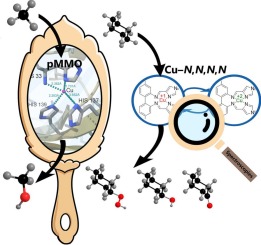
The reactivity of a Cu–N4 complex with an imidazole-based ligand, inspired by the mono-CuB site suggested for particulate methane monooxygenase (pMMO), has been studied by catalytic testing, UV–Vis and XAS spectroscopies and DFT methods. The Cu–N4 complex was synthesized in Cu(I) and Cu(II) initial oxidation states, referred to as 1 and 2, respectively. Both were tested for cyclohexane (CyH) oxidation in acetonitrile (MeCN) at 25 °C and ambient pressure, using H2O2 as co-substrate. 1 showed higher activity in CyH oxidation than 2, with both forming cyclohexyl hydroperoxide (Cy–OOH) as the main product. In situ ultraviolet–visible (UV–Vis) and X-ray absorption (XAS) spectroscopies support a Cu(I)/Cu(II) redox cycle triggered by the excess amount of H2O2. Starting from 2, a slow reduction to Cu(I) and distinct Cu(II) signals, compared to those observed with 1, were detected using operando UV–Vis spectroscopy. Density functional theory (DFT) results suggest both Fenton- (via •OH and •OOH) and Cu(II)–oxyl-mediated reactions from 1 leading to C–H oxidation and H2O2 disproportionation. Kinetic data at 30 min of reaction indicate a ∼1st order reactivity with respect to H2O2 and Cu concentrations, and a fractional (∼0.5) order with respect to CyH, in line with the mechanism proposed by DFT calculations. These reaction orders change at 240 min of reaction, indicating catalyst decomposition by ligand oxidation, hydrolysis, or aggregation. This study highlights the importance of preventing the reaction of Cu(II)–oxyl with H2O2 and Fenton-type chemistry for efficient and selective oxidation of C–H to alcohol, providing hints for further catalyst design.
Click here for the complete article!